
CELEBRATING 150 YEARS by Earl Shreckengast
CELEBRATING 150 YEARS—Centennial Influences on Koester Gardens
We often don’t think about why things are the way they are. That could be said about the gardens at the Koester House Museum & Gardens. What influenced Charles F. Koester’s landscape and gardening decisions?
To answer this question, we go back to something that happened 150 years ago. Charles and his new bride, Sylvia Broughten Koester, and two nieces and two nephews attended the Centennial Exposition in Philadelphia in 1876. There they were exposed to the 285-acre fairgrounds which had massive, architecturally significant exhibit halls and landscaped grounds. The latest products and innovations in agriculture, industry, and arts from around the world were showcased in these exhibit halls. Classical sculptures and fountains were on display throughout the grounds and in the halls.
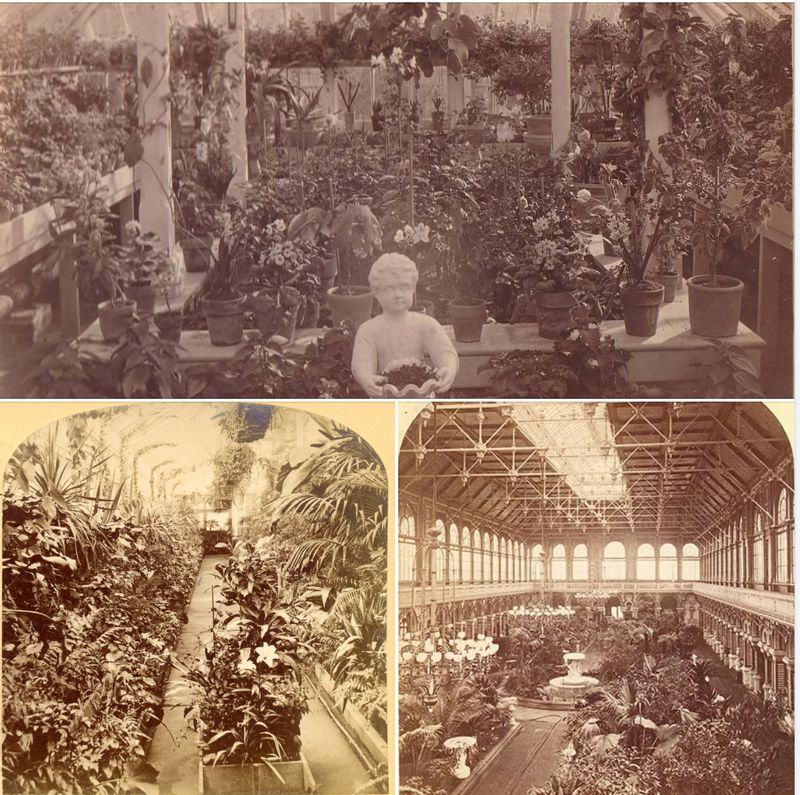
We can’t know everything that was on Charles’ mind as they traveled, but we do have his observations via his daily diary entries. We don’t know everything that they saw, but we have his recounting of what he thought worthy of writing about. He bought stereoscope pictures of some of the places of interest that they visited. These pictures combined with his diary descriptions and historic photos from the time allow us to draw inferences. What did he see that inspired our iconic gardens?
There were several sites visited by Charles and his family during their wedding trip that gave Charles ideas he would incorporate into his plans for their home and garden. In Washington, D.C., they went to the U.S. Botanic Garden. It was a Victorian multi-wing greenhouse that held plant collections brought back by early U.S. maritime expeditions. By 1876, the Botanic Garden displayed tropical plants (palms, orchids, ferns), economic plants (medicinal, food, and fiber species), and rare exotics collected from the Pacific, South America, and Asia.
Although Charles didn’t specifically mention it when writing about their White House visit, he had a stereoscopic photo of the White House’s conservatory. During President Grant’s time, this greenhouse was for growing fresh flowers, foliage, and exotic plants that were used year-round to decorate the White House. There were also propagation greenhouses.
At the Exposition itself, Horticultural Hall was a greenhouse on steroids. It housed tropical plants and large palms, decorative fountains and garden features, international horticultural exhibits, and seasonal floral displays. In addition, some exhibitors such as glass manufacturers and botanical societies built smaller enclosed or semi-enclosed structures for plant display. These were not full conservatories but still greenhouse-like in function.
The takeaways for Charles from these greenhouses were three-fold. He was introduced to many tropical plants and exotics. He learned that plants could be grown outside their typical climate in the controlled environment of a greenhouse. Lastly, he saw how having a greenhouse can be a source of plants and flowers throughout the year.
What did these discoveries mean in Marysville? Ever striving to improve his gardens, Charles considered building a greenhouse. As a first step, he converted the Old Dwelling in 1877 into a makeshift greenhouse as an experiment. Before, he wintered his plants and bulbs in his house’s cellar. He installed a coal stove and found that he could keep the space warm enough for growing plants during the winter. That successful experiment led not only to construction of an actual greenhouse in 1881, but ultimately to the birth of a florist business and the construction of two other greenhouses. Having heated greenhouses allowed Charles to expand what plants he would use. He could overwinter plants such as tropicals and cacti. Just like at the White House, he could bring fresh plants and blooms into his house during the winter.
Today, 150 years later, the greenhouses are gone. They were removed in 1906 by Charles’ son, Charles J.D., when he built his house. The gardens themselves, now concentrated around the museum building (the former home of Charles F. and Sylvia Koester) have been modernized and enhanced through a series of projects that started in 2019. They are a showplace maintained by volunteers.
The interior of Charles’ greenhouse is at the top of the above picture. The White House Conservatory is on the bottom left. The interior of Horticultural Hall is on the bottom right.
Originally posted by Koester House Museum & Gardens via LocableKoester House Museum & Gardens
919 Broadway Street
Marysville, KS 66508
785-562-2417
www.koesterhousemuseum.com
Alert
We're open but with new hours/limited operations!
The museum is closed from November - March for regular tours. Special tours may be arranged. Watch our calendars & posts to announce special events to be held at the museum during our closed winter months.
Tue
10:00am–4:00pm
Wed
10:00am–4:00pm
Thu
10:00am–4:00pm
Fri
10:00am–4:00pm
Sat
10:00am–4:00pm
Sun
1:00pm–4:00pm